A Christmas of Resilience and Remembrance

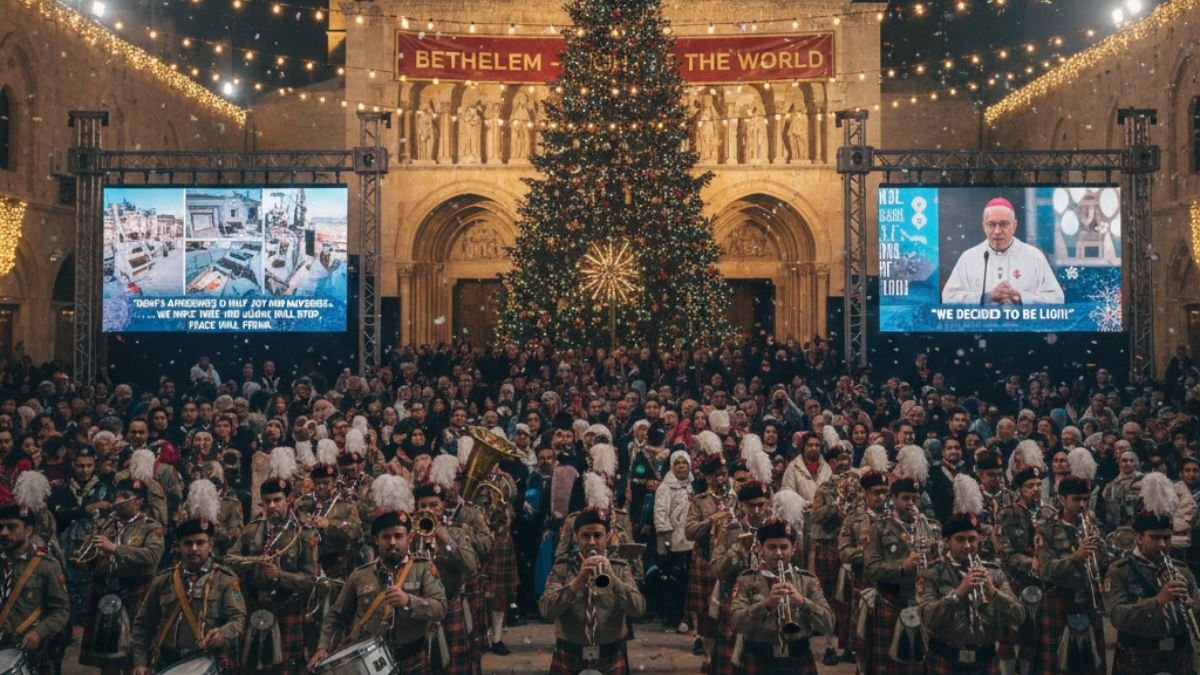
Bethlehem, Dec 25 – For the first time in two years, the narrow alleyways surrounding Manger Square were not silent. They pulsed with the rhythmic beat of drums and the blare of brass instruments as Bethlehem’s scout troupes marched in pristine uniforms, their music heralding a return to tradition in the city believed to be the birthplace of Jesus.
It was a scene of defiant joy. After suspending festivities in 2023 and 2024 in solidarity with Gaza, the city reclaimed its holiday spirit on Wednesday. Yet, beneath the carols and the lights, a profound poignancy lingered—a recognition that while the music had returned, the war was not over.
The atmosphere in Manger Square was a delicate balance of celebration and solemnity. Roughly 1,500 people gathered to mark the occasion, a mix of local Palestinians, foreign visitors, and Palestinian citizens of Israel. For many, the mere act of gathering was a statement of survival.
Pierbattista Pizzaballa, the Latin Patriarch of Jerusalem and the highest-ranking Catholic official in the region, arrived at the Church of the Nativity with a message born from recent experience. Having just returned from witnessing the devastation in Gaza, his address bridged the gap between the festive square and the war-torn enclave.
“In Gaza… I witnessed total destruction,” Pizzaballa told the crowd. “But amid Gaza’s destruction, I felt a passion for life. In the midst of nothingness, people created reasons for joy and celebration.”
He framed the celebrations not as ignoring the suffering, but as a necessary counter-narrative. “We decided to be light, and the light of Bethlehem is the light of the world,” he said.
While the lights shone bright in the square, the journey to get there highlighted the stark reality of life under occupation. For Palestinian Christians living in the West Bank, attending the festivities meant navigating a labyrinth of Israeli military checkpoints and delays.
Hussam Zraiqat, who traveled from near Ramallah, described the disconnect between the holiday spirit and the physical restrictions on movement. “It is true that the atmosphere of joy, love, and peace has returned to us, but the road to Bethlehem was difficult,” he said, noting long waits at checkpoints just to bridge short physical distances.
Ghassan Rizqallah, from the village of Jifna, echoed the sentiment, waiting over an hour and a half to enter the city. Yet, the payoff was visceral. “Watching the scout bands and hearing the music takes us back to the beautiful past of our country,” Rizqallah noted, emphasizing the deep desire for a “normal life” and safety.
Beyond the spiritual and emotional relief, the return of Christmas is a critical economic lifeline for a city that has been on life support. Bethlehem’s economy is heavily dependent on tourism, and the two-year shutdown devastated local businesses, with the Palestinian Hotel Association reporting $300 million in losses this year alone.
Mayor Maher Canawati pointed to the reopening of hotels as a tentative sign of revival. “God willing, the wheel of tourism has started turning again,” he said. Occupancy rates spiked to 80 percent over the holiday, driven largely by domestic tourism—Palestinian citizens of Israel making the journey to support the local economy.
However, for shop owners like Jack Jaqman, the recovery still feels distant. While grateful for the activity, he noted that “real tourist groups” from abroad are still missing. “On this day, we pray for the end of the siege that has turned Bethlehem into a large prison,” Jaqman said, arranging artifacts in a shop that sat empty for too long.
“Today’s atmosphere is half joy and half sadness, because we have brothers who are still dying in Gaza… We hope the war will end, the killing will stop, peace will prevail in the Holy Land.” – George Zalloum, attendee from East Jerusalem
Zalloum’s words capture the duality of this Christmas. It is impossible to fully celebrate without acknowledging the grief that hangs over the region, yet the hope for peace remains the central theme of the holiday.
Bethlehem has successfully broken the silence of the last two years, proving that its traditions are resilient enough to withstand even the darkest times. But as the scouts pack away their instruments and the visitors head back through the checkpoints, the city remains in a precarious position—waiting for a true, lasting peace that goes beyond a single day of celebration.