The Battle for the Desktop: LG Throws a Heavy Counterpunch at Samsung Ahead of CES

Seoul, December 24, 2025 – The arena for the next great tech heavyweight bout is set for Las Vegas, but the first blows are already landing. Just hours after Samsung unveiled its sleek Odyssey OLED G8, confident in its dominance of the high-end display market, domestic rival LG stepped into the ring with a countermove that could fundamentally change the game.
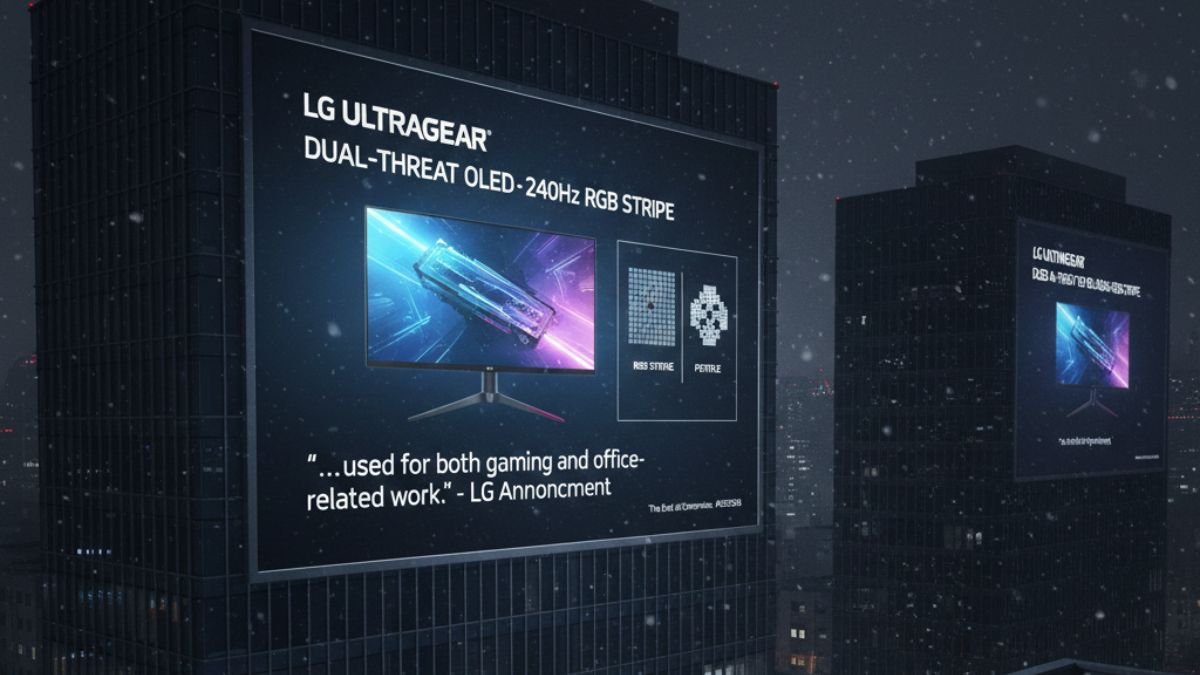
Ahead of the highly anticipated CES 2026, LG has effectively put the industry on notice. The company announced the imminent arrival of the world’s first OLED monitor featuring a 240Hz refresh rate paired with an RGB stripe sub-pixel structure. While the terminology sounds technical, the implication is simple and aggressive: LG is targeting the one weakness Samsung hasn’t arguably fixed.
For years, the OLED narrative has been a tale of two realities. For gamers, the technology offered infinite contrast and blistering speeds, making it the undisputed king of immersion. But for the remote worker or the graphic designer, it often came with a compromise: fuzzy text.
This “fuzziness” was a byproduct of the pentile sub-pixel structures—RGBW or Samsung’s preferred RGBG—where pixels shared real estate, resulting in lower density. Samsung’s latest Odyssey G8, despite its stunning QD-OLED panel and glare-free coating, still relies on this older architecture.
LG’s new announcement strikes directly at this vulnerability. By shifting to an RGB stripe structure, where every pixel is composed of three distinct sub-pixels, LG claims to pack 50% more sub-pixels into the same space compared to traditional layouts. This isn’t just a spec bump; it is an attempt to bridge the divide between a dedicated gaming rig and a professional workstation.
The significance of this move extends beyond mere pixel counting. By solving the text rendering issue that plagues Windows operating systems on OLED panels, LG is positioning its new monitors as the first true “dual-threat” displays.
Until now, professionals often kept a high-refresh OLED for play and a sharp IPS panel for work. LG is betting that consumers are tired of the compromise. By bringing this technology to high-end models first, with plans to trickle it down to entry-level units, they are effectively flanking Samsung. The message is clear: You don’t need two monitors; you just need this one.
Samsung, having just played its hand with the G80SH, now finds itself in a defensive position. While their QD-OLED technology is renowned for color volume, the clarity advantage now sits firmly in LG’s corner. The pressure is mounting on Samsung’s engineers to respond, lest they cede the lucrative “work-from-home gamer” demographic to their fiercest rival.
“LG’s upcoming OLED monitors will not have that disadvantage and could be used for both gaming and office-related work.” – LG Announcement
This statement is a direct challenge to the status quo. It signals that LG is no longer content with being just a choice for entertainment; they want to conquer the desktop in its entirety. It highlights a strategic pivot from pure performance to versatile dominance.
As the tech world descends on Las Vegas next month, the narrative has shifted. Samsung arrived with refinement, but LG has arrived with reinvention. The challenge is now squarely on Samsung to innovate its way out of a corner, as the era of compromising text clarity for gaming performance appears to be drawing to a close.