LG Display Reshapes the Playing Field with Historic Shift to RGB-Stripe OLED


Seoul, South Korea – For years, the battle for dominance in the high-end monitor market has been fought in the trenches of sub-pixel layouts and peak brightness. Now, LG Display has made a move that could fundamentally alter the landscape. In a revelation that addresses one of the most persistent critiques of OLED technology, the manufacturing giant has unveiled its first-ever 27-inch 4K OLED panel featuring a true RGB-stripe layout. It is a calculated departure from their traditional engineering, signaling a new era where text clarity is paramount and visual fringing is a thing of the past.
The narrative of this new panel is defined by a significant structural pivot. Historically, LG Display has relied on “WOLED” technology a method that utilizes a white sub-pixel to boost brightness. While effective for vibrancy, this often came at the cost of text sharpness, a distinct disadvantage when compared to Samsung Display’s competing QD-OLED panels. By abandoning the white sub-pixel in favor of a standard Red-Green-Blue (RGB) stripe, LG is effectively smoothing out the rough edges. This new architecture aligns the sub-pixels in a straight line, a layout that Windows and other operating systems naturally prefer, promising to eliminate the distracting color bleeding that has plagued previous generations.
But this panel isn’t just about reading fine print; it is built for speed. LG Display has integrated its specialized “dual-mode” technology, a feature that allows users to shift gears mid-game. Owners can enjoy the visual fidelity of 4K at a blistering 240Hz, or switch to a lower 1080p resolution to unlock an ultra-responsive 480Hz refresh rate. It is a versatility that bridges the gap between immersive storytelling titles and high-octane competitive shooters.
While the shift to RGB is a triumph for clarity, it introduces questions regarding the panel’s lineage and raw power. The industry is currently buzzing with confusion over whether this unit utilizes LG’s “Tandem OLED” technology—a dual-stack method used in laptops to improve lifespan and efficiency or if it represents a new branch of their 4th Generation development. With the white sub-pixel removed, there is also the matter of luminance. The “additive” nature of pure RGB should result in richer color volume in HDR scenes, avoiding the “washout” effect sometimes seen in WOLEDs, but it remains to be seen if it can match the raw peak brightness of its predecessors without that white booster.
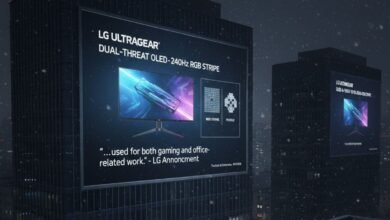
“Developed [our] new pattern optimized for monitor use… it applied various new technologies — such as increasing the aperture ratio… [achieving] the world first of implementing both an RGB stripe structure and a high refresh rate simultaneously.” – LG Display
This statement highlights the engineering tightrope LG has walked. They haven’t just swapped a pixel structure; they have fundamentally re-engineered the aperture ratio the area of the pixel that actually emits light to ensure that high speed and high fidelity can finally coexist without the old compromises.
As the tech world turns its gaze toward CES in Las Vegas this January, all eyes will be on LG Display’s booth. This announcement is currently just a panel reveal, a raw component awaiting adoption by heavyweights like Asus or LG Electronics. However, the message is clear: LG is no longer content to rely on its legacy WOLED architecture for monitors. They have listened to the market, adapted their strategy, and are ready to challenge the competition on clarity, speed, and color accuracy.